What does a small business expect from a door entry system?
Before you choose a specific system, it's worth mapping the real needs of a small business. Most often these are:
- protecting assets and data
- easy employee access management
- quickly revoking permissions
- no complex IT infrastructure
- low deployment and running costs
- ability to check who opened the door and when
The key point is one thing: the system has to be simple to use, yet flexible.
Classic card entry system – how does it work?
How does a card system work?
A traditional card system consists of:
- RFID cards or fobs,
- a reader at the door,
- a controller or access panel.
The employee presents the card to the reader, the system verifies permissions and opens the door.
Pros of card systems
- simple to use,
- quick access to rooms,
- known and proven solution,
- relatively low cost per individual card.
Cons of card systems in a small business
- a lost card = security risk,
- often no remote management,
- physical configuration required,
- limited flexibility when staffing changes.
In practice: a classic card system works, but it's rarely optimal for a small business that needs to react fast and doesn't want to invest in heavy infrastructure.
Is a card-only lock the best option today?
Increasingly the answer is: no.
Small businesses today need more than just cards. That's why smart locks — smart electronic locks — combining card entry with other access methods, are gaining ground.
Smart lock – a modern alternative to card systems
A smart lock is an electronic lock offering several door-opening methods at once, e.g.:
- card or fob,
- PIN code,
- mobile app,
- fingerprint,
- remote.
The whole thing is managed from an app such as TTLock, with no need to install hubs or servers.
Why is a smart lock the best choice for a small business?
Remote access management
- grant and revoke permissions from your phone,
- no need to be physically present,
- ideal for staff rotation.
Security when a card is lost
- the card can be deactivated instantly,
- no need to change the lock or all employees' cards.
Entry history and full control
- the system records date, time and access method,
- the business owner knows exactly who is using the office.
Lower costs and simpler installation
- no central access control system needed,
- fast install even in existing doors.
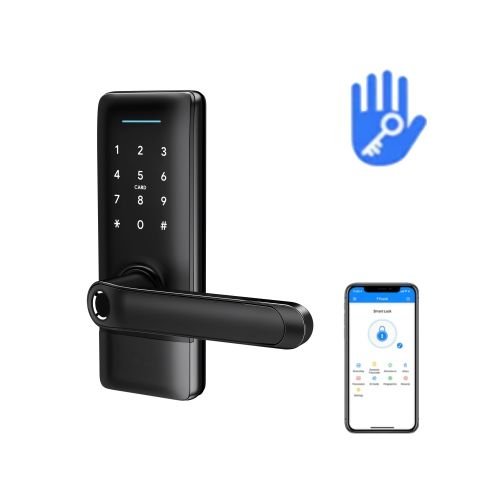
An example solution for a small business – smart lock H15B
A good example of a modern access system is the H15B – an electronic lock designed for small and medium businesses.
It works well in:
- offices,
- consulting rooms,
- service premises,
- short-term rental companies.
It offers:
- access via card, code, app and fingerprint,
- a virtual entry log,
- fast access revocation,
- weather resistance.
It's a solution that combines the simplicity of a card system with the flexibility of a smart lock.